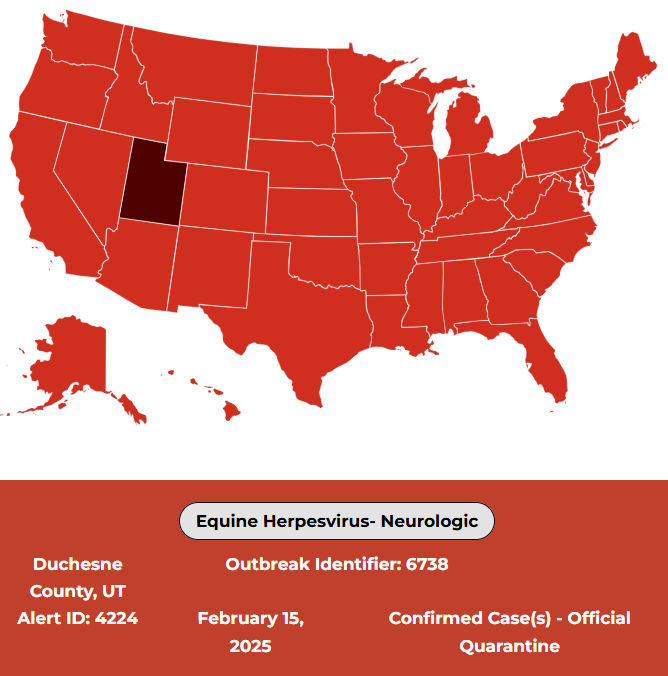
The Equine Disease Communication Center announced on Friday a disease outbreak centered in eastern Utah. There are 2 confirmed cases of ‘Equine Herpesvirus – Neurologic’ in Duchesne County. The source of the information cited by the Equine Disease Communication Center is the Utah Department of Agriculture and Food. Another case of Equine Herpesvirus was confirmed in Box Elder County and there is also one in San Bernardino County, California. Equine herpesvirus (EHV) is a family of equine viruses named by numbers including EHV-1, 2, 3, 4 and 5 with EHV-1,3,4 posing the most risk for domestic horses. EHV is a common DNA virus that occurs in horse populations worldwide. The two most common species are EHV-1 and EHV-4. EHV-1 and EHV-4 most often cause a respiratory disease which is usually mild and self-limiting, and both can cause abortion. EHV-1 and EHV-4 (very rare) can cause the neurologic form of the disease (equine herpesvirus myeloencephalopathy (EHM)) which creates damage to the spinal cord and can be fatal. EHV-3 causes coital exanthema, a venereal disease which affects the external genitalia. Horses can be carriers of EHV with no clinical signs and can spread the disease to other horses. Testing and quarantining affected horses in isolation is the primary way to control the disease. Vaccines are available but do not completely prevent any form of the disease. The best method of protection is always to maintain current vaccinations on all horses on your property and to follow correct biosecurity protocol when bringing new horses onto your premises or when travelling with your horse.